Jason Schneiderman ’98 Receives 2026 Pegasus Award for Poetry Criticism
English and Russian grad receives $10,000 award for essay collection exploring the relationship between poetry and technology.


Research in the School of Languages, Literatures and Cultures is interdisciplinary and vibrant.
Faculty and graduate students pursue research in numerous languages and programs.
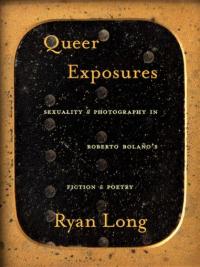
Roberto Bolaño (1953-2003) stands out among recent Latin American writers because of his unique combination of critical acclaim, popularity, and literary significance. Queer Exposures analyzes two central but understudied topics in Bolaño’s fiction and poetry: sexuality and photography. Moving beyond a consideration of how his texts represent these topics, Ryan F. Long demonstrates that, when considered in tandem, they form the basis for a new innovative and critical approach. Emphasizing the processes of exposure associated with photography and sexuality, especially queer sexuality, provides readers and scholars with a versatile method for comprehending Bolaño’s constellation of texts. With close readings of a broad range of texts, from poetry written just after his arrival in Spain in the late 1970s to his posthumously published novels, Queer Exposures concludes that an emphasis on sexuality and photography is essential for understanding how Bolaño’s texts function in dialogue with one another to elucidate and critique the interrelations of writing, visual representation, and power.
Read More about Queer Exposures, Sexuality and Photography in Roberto Bolaño’s Fiction and Poetry
This essay revisits José Antonio Saco’s intellectual contribution to the Hispanic archive that emerges from the recovery of Bartolomé de las Casas’ texts and the colonial connections between indigenous slavery and the African slave trade. Saco adheres to a notion of Hispanism, filtered through Las Casas, that facilitates a multiple and contradictory identification with coloniality, that allows him to anchor, his national, Caribbean, and universal historiographical project in the Hispanic and Black Atlantic. In turn, Saco and the Lascasian legacy that he rescued becomes an important colonial departure for contemporary theorizations: Antonio Benítez Rojo’s Caribbean readings of a paradoxical and complex repeating island, as well as Fernando Ortiz’ vision of a process of transculturation with repercussions beyond the Caribbean.
Ulysses, Europe, Orpheus, and Eurydice are among the mythical characters whose adventures have been illustrated since antiquity in the arts, and for over a century now, in cinema. French filmmakers Agnès Varda, Alain Resnais, Christophe Honoré, and Jean-Jacques Annaud participated in the transmission and rewriting of these Greek myths, each in their own way. In "Ulysses" (1982), Varda combined an autobiographical commentary on a photograph taken in 1954 with a feminist and political perspective on its context, echoing the works of Roland Barthes and Jacques Rancière on photography. Resnais, in "You Ain't Seen Nothin' Yet" (2012), returned to his passion for theater by revisiting two of Jean Anouilh's plays in light of Jean-Luc Nancy and Mathilde Girard's dialogue on myth and performance. "Métamorphoses" by Honoré (2014) offers a transgender reading of mythological stories, in every sense of the word, under the aegis of Jupiter, Bacchus, and Orpheus in order to articulate a liberated but informed vision of the future for younger generations living in a Mediterranean environment. In "His Majesty Minor" (2007), Annaud presents a parody of "The Odyssey" through a critical reading of Greek mythology by the humanities and social sciences
Read More about Cinéma et Mythologie : Varda, Resnais, Honoré, Annaud
The first part of Theo Angelopoulos' career was dominated by references to the myth of the Atreides with the return of the father betrayed by his wife, the plot hatched with her lover leading to his violent death, the suffering of his children, and Orestes' revenge. The story of Ulysses' return to Ithaka later replaced Agamemnon's in his filmography. "The Suspended Step of the Stork" illustrated this theme by depicting the impossibility of the reunion between the modern Ulysses and his Penelope. This article demonstrates that from "Ulysses' Gaze" on, Angelopoulos' narratives became more and more influenced by the Homeric myth. This return to the oldest source of literature allowed the filmmaker to elaborate and express a personal and intimate myth that were developed in "Eternity and a day" and subsequent films.
This article casts Jean-Jacques Annaud's "Wolf Totem" (2015) as a site of cultural negotiation and focuses on Annaud's adaptational dialogue with Jiang Rong's novel (2004) by the same name to turn a deeply local story into a transnational film. Annaud achieves a more general perspective than the Chinese novel by refusing to make any claims to historical accuracy or documentary objectivity. But, as in most of his previous films, he strives to confront social and political reality from a an independent, informed, and critical position. Annauds thus continues to support and embody a struggle for cinema's independence from any political or material constraint while exposing the shortcomings of any representation of an unknown culture that depends on stereotypes and prejudice.
edited by Risako Ide and Kaori Hata.
This chapter compares indexical expressions utilized in English and Japanese email discourse from book companies in the United States and Japan in order to highlight their referential functions and underscore their pedagogical importance. These deictics also serve a marketing purpose by constituting a bond between company and customer and encouraging further patronage. English emails adopt a relatively casual stance, with positive politeness markers such as bare imperatives functioning to invite future customer engagement. Pronominal reference also predominates, whereas in Japanese, recurring combinations of nominal forms with polite prefixes and honorific or humble polite predicates enable a company to express appreciation for a customer’s patronage, acknowledge benefits received, and indirectly index a deferent stance consonant with customer expectations for online vendors.
Read More about Getting to the Point: Indexical Reference in English and Japanese Email Discourse
Dr. Jowel C. Laguerre Ph.D.
Ms. Mickel-Ange Bernier
Learn and improve your Haitian-Creole Skills effectively. Kreyòl Modèn is a comprehensive guide to teach and learn the Haitian-Creole language.
Language standardization is the core of language policy and language planning (LPLP), which are two different sides of the same coin. Focusing on speakers, language policy decides which language – or variety of a lan- guage – students should learn, teachers should use in schools, officials should adopt in government, employers and employees should converse in when conducting business and people should speak in public. On the other hand, by targeting languages, language planning engages the processes of selecting a standard variety or a standard language (status planning) and normalizing the selected language’s or variety’s grammar, vocabulary, pro- nunciation and scripts (corpus planning) so that it may best fulfil its desig- nated functions. Thus, language standardization may be broadly viewed from the perspective of language policy, of language planning or of both. This chapter takes this broad perspective of the standardization of minor- ity languages – languages that are either not spoken by the majority of citi- zens or not designated as the national or official languages of a nation-state.
Read More about Standardization of Minority Languages: Nation-State Building and Globalization